Start Here: The 60-Second Rodent Check
This page helps you read the signs of rodents in your house before you decide what to do. It starts with four signs you can check in about a minute, then covers droppings, sounds, and what each part of the house shows. One caution belongs at the top: a single sign can mislead you. One dropping can be old, and one night of noise can be a duct cooling down, so line signs up and note whether they are fresh and repeated.
Detroit housing shapes where signs show up. About 86 percent of Detroit residential structures were built before 1970 (City of Detroit NRSA plan, using ACS 2020 data) and 34.8 percent of housing units were built in 1939 or earlier (ACS 2022 5-year data). About 72 percent are single-family homes including attached homes (ACS 2022). That age of stock brings settled foundations, old utility openings and connected wall voids.
Start with the four signs that settle most questions about signs of rodents in your house: droppings, sounds, grease marks and gnawing. You need a flashlight and a way to record each find.
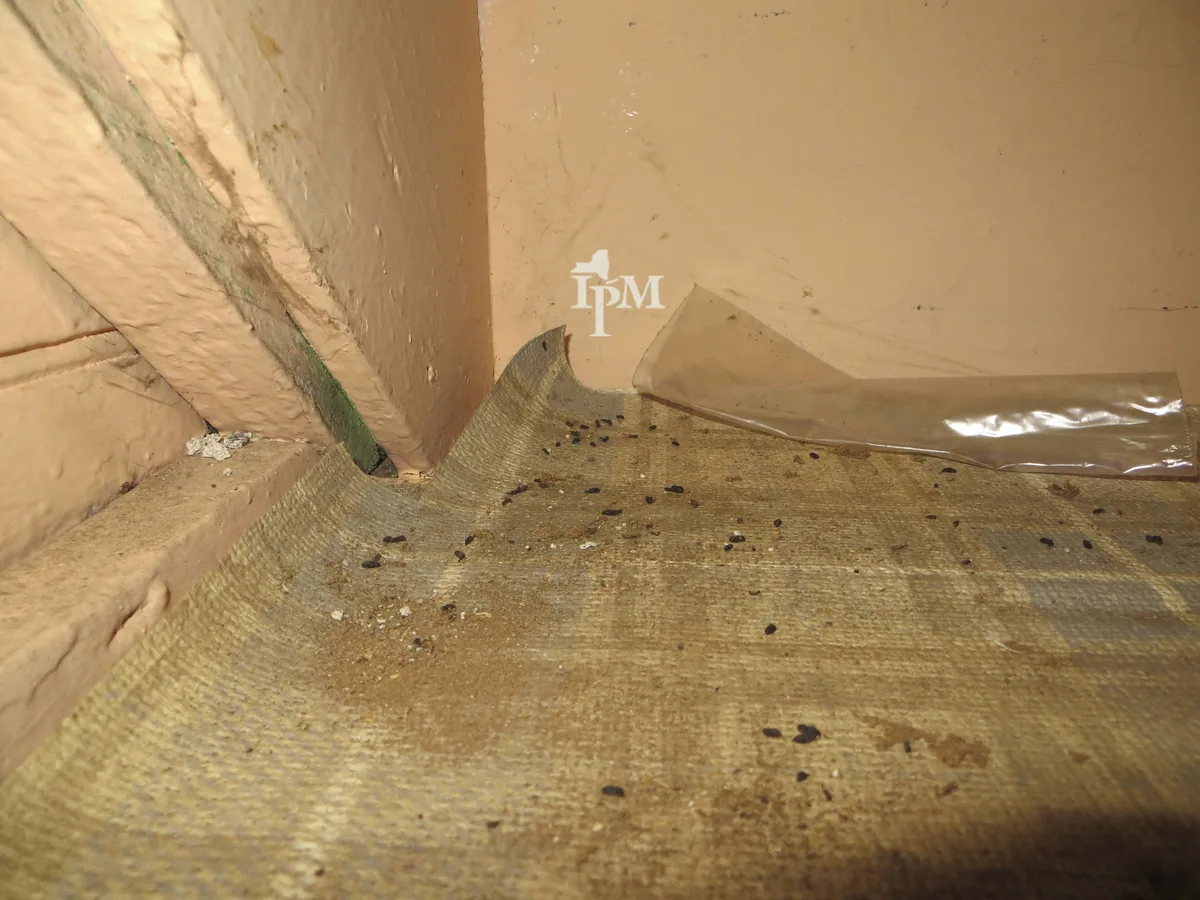
First, droppings. Look along baseboards, behind the stove and refrigerator, inside the cabinet under the sink, along basement walls and on attic boards near the hatch. A line along a wall or a cluster in a quiet corner carries more weight than a single pellet mid-floor. Note size and shape before you clean up. That is how you tell mouse from rat in the next section.
Second, sounds. Stand quietly where you hear noise and note the time, the place, and the type of sound. Light scratching after dark points one way. Heavier thumps or daytime noise point another way. The sounds section below breaks each pattern down.
Third, grease marks. Mice and rats use the same routes night after night, and their fur leaves dark smears along wall edges, around pipes and through gaps. Look for grey to black smudge lines at floor level. A fresh mark looks dark and soft. An old mark looks faded and dry.
Fourth, gnawing. Check food packaging, stored box edges and soft material near a wall. Rodents gnaw to keep their front teeth worn down, so paired tooth marks on packaging, wood or plastic are a real sign even with no droppings. Gnawed wiring is covered in the questions below, because wiring changes the urgency.
Write down what you found and where. A note naming the room and the sign beats a general feeling that something is in the house. If two or more signs line up, or signs keep appearing after you clean, the next step is to book a rodent inspection so the entry routes behind those signs can be checked in person.
Droppings: How to Tell Mouse From Rat
Droppings are the most reliable sign on this page because you can measure them. Size, shape and the shape of the ends do most of the identification work.
House mouse droppings are small. Each one is about 3 to 6 millimetres long, roughly the length of a grain of rice. The shape is thin and spindle-like, and the ends come to a point. Mice drop them as they move, so you find them spread along baseboards, in drawers, on pantry shelves and along attic boards rather than in one pile.
Norway rat droppings are much larger. Each one is about 18 to 20 millimetres long, roughly three quarters of an inch. The shape is thick and capsule-like, like a dark olive pit, and the ends are blunt and rounded. Rats use a more fixed latrine area than mice, so their droppings often collect in one corner of a basement, crawl space or garage.
Freshness matters as much as size. Fresh droppings are dark, almost black and slightly moist. Old droppings are grey, dry and hard, and they turn to dust. Fresh droppings mean the route is in use now. Grey, dusty droppings with no dark ones on top can mean an old problem that has ended, so clean a test area and recheck it a few days later.
Mouse droppings in kitchen drawers and pantry cupboards mean mice are feeding where you store food. Rat droppings low in the house fit the Norway rat pattern of living close to the ground. Attic droppings need a separate check against squirrel sign, covered below.
Handle droppings with care. Wear disposable gloves. Do not sweep or vacuum dry droppings, because dry sweeping stirs dust into the air you breathe. Spray the droppings and the area around them with disinfectant until wet, let it sit, then pick everything up with paper towels, bag it and use an outside bin. Wash your hands afterwards, and wash any food surface before you use it again. A handful in one drawer is a clean-up you can do this way. A heavy build-up through attic insulation is a different scale of job, and professional droppings cleanup covers that larger clean-up and sanitation work.
If the size sits between the two patterns, or fresh droppings keep appearing in a place you cannot reach, get the entry-point check and have the droppings read alongside the entry routes.
Signs lining up in more than one room? Have the species and the entry routes confirmed in person.
Call (313) 555-0100Scratching, Scurrying, and Other Sounds Explained
Sounds tell you when an animal is active, how heavy it is and roughly where it travels. They rarely settle the species alone, so read them with the droppings and marks from the check above.
The pattern behind scratching in walls at night is timing. House mice and Norway rats are mainly active after dark, with peaks just after dusk and again before dawn. Light, quick scratching that moves along a wall and pauses fits a mouse travelling a wall void. Short bursts of scurrying across a ceiling fit mice moving over ceiling boards. Mouse noise is faint, so you may hear it in a quiet bedroom and miss it in a busy living room.
Rat noise is heavier. Expect slower scratching, dull thumps when an animal lands, and a dragging quality when a rat crosses a loose board. Rat gnawing is louder and steadier than mouse gnawing and can sound like slow scraping on wood. Brief squeaks alone do not prove rodents, because pipes and ducts also make high sounds as they heat and cool.
Some sounds have a plain non-rodent cause. Heating ducts tick and pop as they warm and cool, in a rhythm tied to the furnace cycle. Water pipes can knock inside a wall after a tap runs. Birds can scratch in a chimney or vent in daylight. Wind can tap a loose vent flap. If the sound follows the furnace cycle minute for minute, note that pattern before you treat it as animal noise.
Squirrels explain a share of attic noise in Detroit. They are active in the day, especially early morning and late afternoon. Rolling sounds and fast scampering in daylight fit squirrels far better than mice or rats. Night noise inside wall voids fits rodents better. Squirrel problems route to a wildlife service rather than a rodent service.
Keep a short sound log for two or three nights if the pattern is unclear: start time, room, wall or ceiling area and burst length. That log turns a vague worry into usable evidence. When it shows repeated night activity in the same void and droppings confirm the species, the gap the animals use has to be found and closed, and sealing every entry point is the service that handles that closing work.
Signs by Location
The same animal leaves different sign in different parts of a house, and wall voids, pipe chases and attic floors connect these spaces, so sign in two connected places usually describes one route, not two problems.
Attic
Mice in attic spaces leave a clear pattern. Check along the boards near the hatch, along the top plates of the walls below and around pipes and wires through the ceiling. Mouse droppings in the attic follow those runs in loose lines. Look for nesting made from shredded insulation, paper or fabric in a quiet corner, and for dark rub marks where a route crosses a joist.
Mice in attic insulation also tunnel. Soft, disturbed patches, shallow trails in loose fill and droppings mixed into the top layer point to mice nesting inside the insulation itself. Trapping below will keep missing animals that live above the ceiling, and heavily soiled insulation has to be dealt with alongside removal.
Sound helps you read the attic. Light scurrying over the bedroom ceiling after dark, with droppings along the runs, fits mice in attic areas of the house. Heavy rolling in daylight fits squirrels, and a raccoon produces much heavier thumps than any rodent on this page. Do not climb into an attic with poor flooring. A look through the hatch with a strong light shows the main runs.
If the hatch check shows droppings and nesting spread through the insulation, the job has two parts: dealing with the animals and dealing with the material they have lived in. For the material side, attic cleanup and sanitation covers removal of soiled nesting and insulation after the infestation clears.
Walls and Ceilings
Wall voids are travel routes. Mice and rats move inside walls between the basement and the attic, pausing where pipes, wires and studs give them grip and cover. You will rarely see droppings inside a closed wall. What you get instead is sound at night, a faint musky smell near an outlet in a bad case, and sometimes a grease smear where the route enters a room.
Ceilings collect the sign that the space above produces. Droppings on a ceiling tile, spreading staining, or scurrying from a light fitting point to activity directly above. Note which room sits under the noise. A route over a kitchen ceiling raises a food-hygiene point that a route over a garage ceiling does not.
Do not open a wall on sound alone. A wall should only be opened when other sign confirms an animal or a carcass is in that exact section, because most wall noise comes from animals passing through. The useful work at this stage is mapping: which walls carry sound, at what hours, and which basement and attic points line up with them. When sound in the same wall repeats night after night and droppings confirm mice or rats in the house, the route feeding that wall has to be closed from the outside or the low level where it starts. That closing work is rodent exclusion, meaning sealing every entry point that feeds the voids, done after the animals inside have been dealt with.
Basement
The basement is the low-level centre of most Detroit rodent problems, suiting the Norway rat pattern of living close to the ground. Check the top of the foundation wall where the house frame sits, often called the sill area, for gaps, rub marks and droppings on the ledge. Check along the foundation walls for grouped droppings, and look around the water heater and furnace, where warmth, water and cover come together.
Detroit code defines rat harborage as any condition under which rats may find shelter or protection (2019 Detroit City Code, Section 8-15-3). Boxes tight against a foundation wall, cluttered corners and pet food at floor level all give shelter or food at the level rats use. Clearing cover from the foundation line will not remove rats by itself, but it stops sign from hiding.
Old openings deserve a look in pre-1970 stock. Coal chute doors, sealed utility entries, gaps where pipes pass through block or stone, and cracks where a porch meets the main foundation are places an inspection checks in houses of this age. Treat them as check points, not as a verdict on your house. Floor drains and sump areas are also check points for droppings and disturbance. Sign near a drain does not by itself prove how an animal entered. If basement sign shows grouped rat droppings and rub marks at the sill, the active animals need to be removed first, and rat trapping and removal covers that removal work for rats at this level of the house.
Crawl Space
A crawl space hides sign well, so problems there often run longer before anyone notices. From the access opening, look with a strong light for droppings on the soil or vapor barrier, nesting against a foundation wall or around a pipe, and disturbed insulation hanging between the joists above. Trails in dust or soil are another clear marker.
Check the vents and the access door before you assume a hidden entry. A loose vent screen, a warped panel or a gap where a pipe passes through the foundation can each give mice a route in, and rats can widen a weak point at ground level. Smell often gives a crawl space away. A strong musky odour at the access opening points to nesting, droppings build-up or, in the worst case, a dead animal under the floor. The smells section below explains how to read that difference. Because access is tight and sign is easy to miss from the doorway, confirmed droppings or a persistent odour here make a strong case for an in-person check of the full perimeter. You can arrange that check when you book a rodent inspection and note the crawl space access on the call.
Kitchen and Pantry
The kitchen is where mouse sign matters most, because it puts droppings and gnawing next to food. Check inside the cabinet under the sink, where pipe openings are a classic mouse route in. Check behind the stove and refrigerator, pantry corners, drawers, and the back edge of worktops.
Mouse droppings in the kitchen are usually scattered in small numbers along those runs. Gnawed packaging tells its own story: small paired tooth marks and tiny holes in cereal boxes, grain bags and pet food sacks, often at the lower corners. A thin grease smear behind the stove confirms a repeated route. If you find droppings on a food surface, clean and disinfect it before food touches it again, and move bagged food into sealed containers.
Rat sign in a kitchen is less common and carries more weight when it appears. Larger droppings at floor level, heavy gnawing on a cabinet base, or a rat seen in the kitchen points to a low-level route that has reached the living space, and that pattern should be treated as urgent rather than watched. For the common kitchen pattern, ongoing mouse trapping and monitoring covers the trapping and repeat checks that clear mice from food areas and confirm they have stopped coming.
Garage
Garages give rodents cover, stored food such as bird seed and pet food, and a door line that rarely seals well. Check the corners where the door meets the floor and frame, because a gap that lets daylight in will let a mouse in. Check the wall shared with the house, stored boxes and items that never move.
Size garage droppings the same way as indoor droppings. Mouse pellets along the walls fit mice sheltering among storage. Larger, blunt-ended droppings grouped in a corner, plus disturbed soil just outside the garage wall, fit Norway rats working the building line. Also look for nesting in stored fabric and gnawing at floor level.
The garage connects to the alley line in many Detroit homes. The city stopped maintaining residential alleys in the late 1980s, and upkeep has been the homeowner's job since then. Overgrowth and clutter along your own garage and alley line give rats shelter right against the building, so clearing your side of that line matters. When garage sign traces back to door corners and frame gaps, those gaps need closing with materials rodents cannot chew through. That work sits with sealing garage gaps and door lines as part of a wider sealing job on the house shell.
Yard and Burrows
Yard sign centres on burrows. A Norway rat burrow is a hole about 2 to 4 inches across, usually against a foundation, under a porch, along a garage wall or near a fence line. An active burrow has a smooth, worn entrance, loose fresh soil fanned out beside it and sometimes a clear run worn through grass from the hole to cover. An old burrow looks soft at the edges, with no fresh digging.
Test a burrow before you judge it. Loosely fill the entrance with soil or crumpled paper in the morning and check it the next day. An active burrow will be reopened. A burrow that stays filled is likely inactive. Also look for droppings near the entrance and disturbance around bins and compost.
Context matters in Detroit yards. The city counted 87,699 vacant housing units, about 24 percent of its stock (City of Detroit NRSA plan, Census 2020 base), and Detroit Future City counted more than 100,000 vacant lots in October 2025. An empty house or vacant lot next door can give rats shelter close to your home. Nearby vacancy can provide harborage near your property, and it does not by itself prove where the rats using your yard came from. Keep your own bins closed and clear harborage along your own lines. If burrows are active and rats also show sign at the foundation, yard work alone will not settle it. For an active rat problem working the yard and the building line together, ask for help with an active rat problem and describe the burrow locations when you call.
Apartments and Shared Spaces
Rodents in an apartment building move through shared routes: wall voids, pipe chases and utility runs that connect one unit to the next. Sign in one flat often means the route serves several flats. Look for the same kitchen and wall sign described above, plus droppings around shared pipe runs and bin stores.
Rats seen in a shared space such as a lobby, stairwell or bin area are a building-level sign. So are droppings repeated across more than one unit on the same pipework. Record the date, time and exact place of any sighting. A dated record helps a landlord or manager scope the problem across units instead of treating each report as isolated.
Responsibility in a Detroit rental sits with the owner. Rental properties must be registered and hold a Certificate of Compliance, and violations go to the owner. Tenants should report sign promptly in writing and keep food storage sealed, while building-level routes and shared areas are the owner side of the job. When sign appears in more than one unit or a rat has been seen in a shared area, the building needs a coordinated response rather than work in one flat alone. In that position, the owner or manager should arrange rodent control help for the building and have the shared routes checked across the affected units.
Rats, Mice, and Other Animals: Species Clues That Fit Michigan
Getting the species right decides the work. Traps, sealing sizes and check places all change between a mouse problem and a rat problem, so use the clues below as a set.
The house mouse is the small indoor species. An adult is about 2.5 to 3.75 inches long in body, with a tail the same length again, large ears and a pointed nose. Mice are curious and investigate new objects quickly. They can pass through a gap about a quarter of an inch wide, roughly the width of a pencil, which is why mouse sealing work has to close very small openings at cabinet, pipe and door level. When nights drop into the 40s and 30s, mice push indoors looking for warmth and food, and indoor sign often rises then.
The Norway rat is the rat species established in Detroit. An adult is about 7 to 9.5 inches long in body, with a thick build, a blunt nose, small ears and a tail shorter than its body. Norway rats live low. They burrow along foundations, shelter in basements and crawl spaces and travel along ground-level runs and alley lines. They are wary of new objects, so a new trap can be avoided for days. That wariness is one reason rat work runs on a check cycle rather than a single visit.
Roof rats need a plain correction, because at least one competitor serving this market describes them as common in Michigan. Roof rats are not established in Michigan. They are a species of warmer coastal and southern regions, and a Detroit attic problem should not be diagnosed as roof rats. Attic sign here points to house mice, to squirrels, or in a heavier case to a raccoon. A plan built around a species that is not established here wastes the visit and misses the real route.
Other animals explain some sign. Squirrels work attics in daylight and roll or drop hard food items such as nuts, which produces rolling sounds no mouse makes. Raccoons produce heavy attic movement, large droppings and torn entry points at roof level, and they are a wildlife job rather than a rodent job. Bats produce small droppings that crumble to powder and are protected wildlife. Naming these alternatives protects you from paying for rodent work aimed at the wrong animal.
Put the clues together like this. Small pointed droppings, faint night scratching in walls and gnawed packaging describe a house mouse problem. Large blunt droppings, burrows at the foundation and heavy night sounds low in the house describe a Norway rat problem. If your sign mixes the two patterns, have the species confirmed in person before any treatment is chosen, starting with mouse control for a confirmed mouse pattern or a rat exterminator for a confirmed rat pattern.
Rodent Smells and What They Can Mean
Smell is the vaguest sign on this page, so treat it as a pointer rather than a verdict. Three patterns cover most rodent cases.
A sharp, stale urine smell in a cupboard, basement corner or attic, often with a musky odour underneath it, usually means rodents have been living and travelling in that area for some time. Mice scent-mark their routes with urine, so a strong smell along a run fits repeated mouse use of that route. It builds slowly, and you may only notice it in a cupboard that stays closed for days.
A sweet, sickly smell that appears over a few days, peaks and then fades over one to three weeks usually means a dead animal in a wall, ceiling, crawl space or attic. The smell is strongest in the room closest to the carcass. A single dead mouse can produce a noticeable smell in a small room. A dead rat produces a stronger smell that lasts longer. If the smell follows recent trapping or poison use, that timing matters, because animals that die inside a void after feeding elsewhere are a common cause.
A general musty smell on its own proves very little. Damp, mould, a dry drain trap and old stored material all produce musty odours in older houses. Smell earns its weight when it arrives with droppings, sounds or gnawing in the same area. On its own, note it, ventilate the space and recheck in a few days for the harder signs in the 60-second check. If the pattern fits a dead animal and the smell is strong enough to affect daily life in the room, locating and removing the carcass is a defined job with its own methods for finding the source before any wall is opened. That job is covered by removing a dead rodent from a wall or ceiling, including the sanitation that follows removal.
What to Do Next
Match the next step to the strength of the sign you found. Strong, fresh and repeated sign needs a booked check or a call. A single weak sign can be watched for a few days, provided you watch it properly.
Book a check when two or more signs line up, when fresh droppings keep appearing after cleaning, when scratching in walls at night continues in the same wall for a few nights, or when you cannot reach the area where sign collects. A check confirms the species, finds the entry routes and separates a problem from old sign. Jobs booked through this site are fulfilled by an independent, Michigan-licensed pest control operator, and this site connects you with that operator rather than doing the treatment itself.
Call the same day when an animal is loose in a living space, when a rat has been seen indoors, when gnawed wiring is exposed, or when droppings collect in a kitchen used by young children. Those cases should not wait. Describe what you saw, where and when, and keep people and pets out of that room until you have been told how the visit will run. The emergency page linked in the header covers what counts as urgent.
Watch and wait only in the narrow case where it is honest to do so: one old sign, no fresh droppings on a cleaned test area after three or four days, no repeated sound and no sign in any food area. Clean the test area, note the date and check again on a set day. If fresh sign appears, the watch period is over and the case moves to a booked check. Whichever route fits, keep your notes. The rooms, dates, droppings sizes and sound times you recorded will shorten the first visit, because the work can be scoped against evidence instead of a general description. To start, book a rodent inspection and bring those notes with you.
Start Here: The 60-Second Rodent Check
- Look for droppings along baseboards, behind the stove and refrigerator, inside the cabinet under the sink, along basement walls and on attic boards near the hatch
- Stand quietly where you hear noise and note the time, the place and the type of sound
- Look for grease marks, grey to black smudge lines at floor level, along wall edges, around pipes and through gaps
- Check food packaging, stored box edges and soft material near a wall for gnawing and paired tooth marks
- Note the size and shape of droppings before you clean up
- Write down what you found and where, naming the room and the sign
Signs of Rodents in Your House
| Sign | What it usually means | What to do next |
|---|---|---|
| Droppings | Mouse droppings are small, thin and pointed at the ends, and are spread along baseboards, drawers, pantry shelves and attic boards. Rat droppings are much larger, thick and blunt at the ends, and often collect in one corner low in the house. Fresh droppings are dark and slightly moist, and old ones are grey, dry and hard | Note size and shape before you clean up, clean a test area and recheck it a few days later, and book a check if fresh droppings keep appearing |
| Scratching and scurrying at night | Light, quick scratching that moves along a wall after dark fits a mouse travelling a wall void. Slower scratching, dull thumps and a dragging quality fit a rat. Noise that follows the furnace cycle minute for minute can be a duct or pipe instead | Keep a short sound log for two or three nights, noting start time, room, area and burst length, and book a check when the same wall repeats night after night and droppings confirm the species |
| Grease marks | Mice and rats use the same routes night after night, and their fur leaves dark smears along wall edges, around pipes and through gaps. A fresh mark looks dark and soft, and an old mark looks faded and dry | Record where the mark runs and line it up with droppings, sounds or gnawing, because a single sign on its own can mislead |
| Gnawing | Rodents gnaw to keep their front teeth worn down, so paired tooth marks on packaging, wood or plastic are a real sign even with no droppings | Check packaging and stored boxes near walls. If wiring is gnawed or exposed, call the same day and have an electrician check the wiring once the animals have been dealt with. |
| Burrows in the yard | A Norway rat burrow sits against a foundation, under a porch, along a garage wall or near a fence line. An active burrow has a smooth, worn entrance and loose fresh soil fanned out beside it | Loosely fill the entrance in the morning and check it the next day. A reopened burrow is active, and if rats also show sign at the foundation, yard work alone will not settle it. |
| A sweet, sickly smell | A smell that appears over a few days, peaks and then fades usually means a dead animal in a wall, ceiling, crawl space or attic, strongest in the room closest to the carcass | Treat smell as a pointer, not a verdict, and line it up with harder signs. If it is strong enough to affect daily life in the room, locating and removing the carcass is a separate job. |
Related Services
Rodent Inspection Detroit MI
A full check of kitchens, attics, basements, crawl spaces, garages and the alley line, ending with an entry-point map and photos. Start here when you have signs but no certainty about the animal or the route in.
Rodent Exclusion Detroit MI
Exclusion means sealing every entry point: coal chutes, block and stone foundations, sill plates, porch lines and garage gaps, closed with materials rodents cannot chew through. The step that stops new animals using the same routes.
Rodent Droppings Cleanup Detroit MI
Safe handling and sanitation for droppings in attics, kitchens and garages, with guidance on how much is reasonable to clean yourself and when the amount or the place makes it a professional job.
Frequently Asked Questions
Can rodents chew through walls or wires?
Yes. Mice and rats gnaw constantly to wear down teeth that never stop growing, and they can chew through drywall, soft wood, plastic, insulation and the coating on electrical wires. Exposed or damaged wiring should be checked by an electrician once the animals have been dealt with, and the gaps around wires and pipes should be sealed as part of the closing work.
I have rats in my attic - who do I call?
Call for an in-person check first, because heavy attic noise in Detroit more often turns out to be squirrels or mice than Norway rats, which live low and burrow at ground level. A check confirms the animal from droppings, entry points and sound timing before any removal work is booked. The city handles exterior baiting only and does not do interior work, so an animal inside the home needs a private operator.
When to call rodent control?
Book a check when two or more signs line up, when fresh droppings keep appearing after cleaning, when scratching in walls at night continues in the same wall for a few nights, or when you cannot reach the area where sign collects. Call the same day when an animal is loose in a living space, when a rat has been seen indoors, when gnawed wiring is exposed, or when droppings collect in a kitchen used by young children. A single old sign with no fresh droppings on a cleaned test area after three or four days and no repeated sound can be watched for a few days instead.