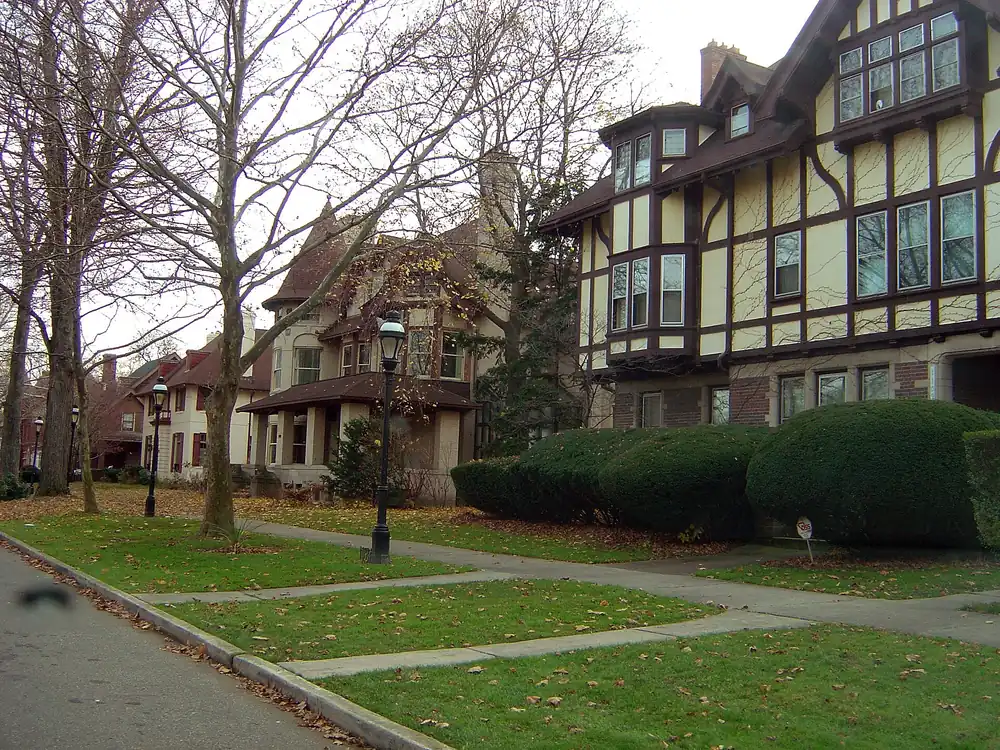
Long Foundation Lines on Large Early-1900s Lots
Walk the outside of an Indian Village house and the first fact is distance. These are large early-1900s homes on tree-lined east-side streets, and a large house on a wide lot has a long foundation line: front wall, two side walls, rear additions, porch junctions and often a linked or nearby garage, each metre of it a place where mortar, wood and old utility work meet the ground. Rodent work here starts with that perimeter, checked slowly, because the openings in a big shell are rarely dramatic. They are a failed joint at a rear corner, a soft-filled hole where a line was moved decades ago, a sill section that has rotted behind a shrub.
The foundations under these homes are of their era, block, brick and stone among them, and the ageing pattern is the same one found across Detroit, where about 86 percent of residential structures predate 1970 and this district sits well inside the oldest share of that stock. Mortar opens at joints, more at corners and at the ground line. Where a house has been extended, the seam between the original wall and the addition is its own check, inside and out, because two building campaigns rarely age at the same rate.
Outbuildings extend the perimeter further. Many Indian Village homes have carriage houses, and others have substantial garages or garden buildings. Each stands on its own foundation with its own doors. The inspection treats the lot as one property with several shells, and the map keeps each building's list separate so nothing is closed on the main house while an outbuilding stays open and active a few steps away.
Attic Voids, Wall Voids and the Space Between Floors
Inside a large older shell, the voids are the travel network. Attic voids above the top floor, wall voids between rooms, and the chases and boxing built around pipes and ducts over a century of alterations let mice move through a house without crossing an open room. That is why reports in these homes often sound scattered: droppings in a top-floor closet, scratching over a bedroom, a pantry sign weeks later. Scattered signs in a big house usually read as one population using the voids, not several separate problems, and the inspection tests that reading by checking the attic and the basement, the two ends of most void runs.
The attic check in an early-1900s home covers eaves and soffits under mature trees, the junctions where roof planes meet, old vent openings, and the tops of chases and wall voids. Nesting and droppings are mapped by bay where the space allows, because the pattern shows which entry level is in use. The basement check covers the other end: chute and cleanout fittings where they survive, utility penetrations, and the sill line checked from inside where siding hides it outside.
Mice move indoors from September to February in Detroit, and large houses with quiet upper floors can hold activity for a long time before it is heard. A check made in early autumn, before the first fall frost around October 24, is worth more in this stock than a check made after signs reach the living floors.
In Indian Village and finding signs along the foundation or in an outbuilding? Call to book an inspection and get every building checked.
Call (313) 555-0100One Plan for the House and Its Outbuildings
A job here begins with a full inspection of every building on the lot, recorded as an entry-point map with photos: foundation line by foundation line, attic, basement, carriage house or garage. Jobs booked through this site are handled by an independent Michigan-licensed operator, and the written quote follows the map. For a property run as one household, whole-house rodent work keeps the main house and outbuildings in a single plan with a single follow-up cycle.
Clearing is placed where the map shows activity, in the attic, the voids or the outbuilding, and checked until activity stops. Mouse trapping and monitoring is the usual core inside a large house, set along the runs the voids create rather than only in the rooms where signs were seen. Where attic signs have built up over time, attic cleanup follows clearing and sealing, in that order.
Sealing then works the lists building by building: entry-point sealing with masonry repair at open joints, mesh and metal at chute, vent and chase openings, tight packing at pipe holes, and outbuilding doors resealed at the floor. Follow-up visits walk the same perimeter the first visit mapped, rechecking each sealed point and looking for fresh signs along the long lines where a new gap would show. On a lot of this size, that written map, kept and rechecked, is the difference between a house that stays closed and a round of separate call-outs for what was one connected shell all along.
Problems and pain points in Indian Village
Scattered signs are the common frustration in a large early 1900s home: droppings in a top floor closet, scratching over a bedroom, a pantry sign weeks later. It is easy to treat each sign as a separate problem and easy to fear hidden damage in the wall and attic voids behind them.
A single plan answers both worries. The inspection checks the attic and the basement, the two ends of most void runs, maps every building on the lot with photos, and quotes in writing from that map. Follow up visits walk the same long perimeter and recheck each sealed point.
Common entry points in Indian Village homes
| Housing feature | Where rodents get in | What closes it |
|---|---|---|
| Long foundation line | Failed mortar joints at rear corners and at the ground line along a long perimeter | Masonry repair at open joints, often with mesh backing |
| Addition seam | Gap where the original wall meets a later addition, inside and out | Seam sealed with materials that fit both building sections |
| Soft filled utility holes | Holes left where a line was moved decades ago | Holes packed tight with chew proof material |
| Rotted sill section behind shrubs | Opening where the sill has rotted where siding and planting hide the line | Rotted section repaired and the sill line sealed |
| Attic eaves and old vent openings | Gaps at eaves, soffits and roof junctions under mature trees, and open vent tops of chases | Eave and soffit gaps closed and vent and chase openings covered with metal or mesh |
| Carriage house or large garage | Its own foundation gaps and doors that do not seal at the floor | Outbuilding doors resealed at the floor and foundation line repaired |
Signs to check in Indian Village homes
- Droppings in top floor closets or scattered rooms
- Scratching over bedrooms at night
- Nesting and droppings mapped by attic bay
- Open mortar joints at foundation corners and rear additions
- Chute and cleanout fittings in the basement
- Utility penetrations and the sill line checked from inside
- Droppings in the carriage house or garage
Rodent services in Indian Village
Every Indian Village job is part of the wider service area covered across Detroit, and each service below is described in full on the main Detroit rodent control page.
Rodent Exclusion Detroit MI
Exclusion means sealing every entry point: coal chutes, block and stone foundations, sill plates, porch lines and garage gaps, closed with materials rodents cannot chew through. The step that stops new animals using the same routes.
Rodent Inspection Detroit MI
A full check of kitchens, attics, basements, crawl spaces, garages and the alley line, ending with an entry-point map and photos. Start here when you have signs but no certainty about the animal or the route in.
Mouse Control Detroit
Ongoing control for mice in attics, walls and pantries when one round of shop traps keeps failing. Built on trapping and monitoring, with the entry gaps behind the problem part of the plan.
Frequently Asked Questions
Why do signs appear in different rooms weeks apart?
In a large early-1900s house, mice travel inside wall voids, attic voids and pipe chases, so one population can leave signs on several floors without crossing open rooms. The inspection checks the attic and basement, the two ends of most void runs, to test that pattern before trapping is placed.
Is the carriage house checked on the same visit?
Yes. Each outbuilding has its own foundation line and doors, and an active carriage house a short run from the main house can keep supplying animals to the lot. It is inspected as its own building, listed separately on the map, and sealed inside the same plan as the house.
What does sealing a long foundation line actually involve?
Item by item, with the material that fits each opening: masonry repair for open mortar joints, often with mesh backing, metal or mesh covers for chute, vent and chase openings, and tight chew-proof packing around pipes. The follow-up visit rechecks each item on the map.