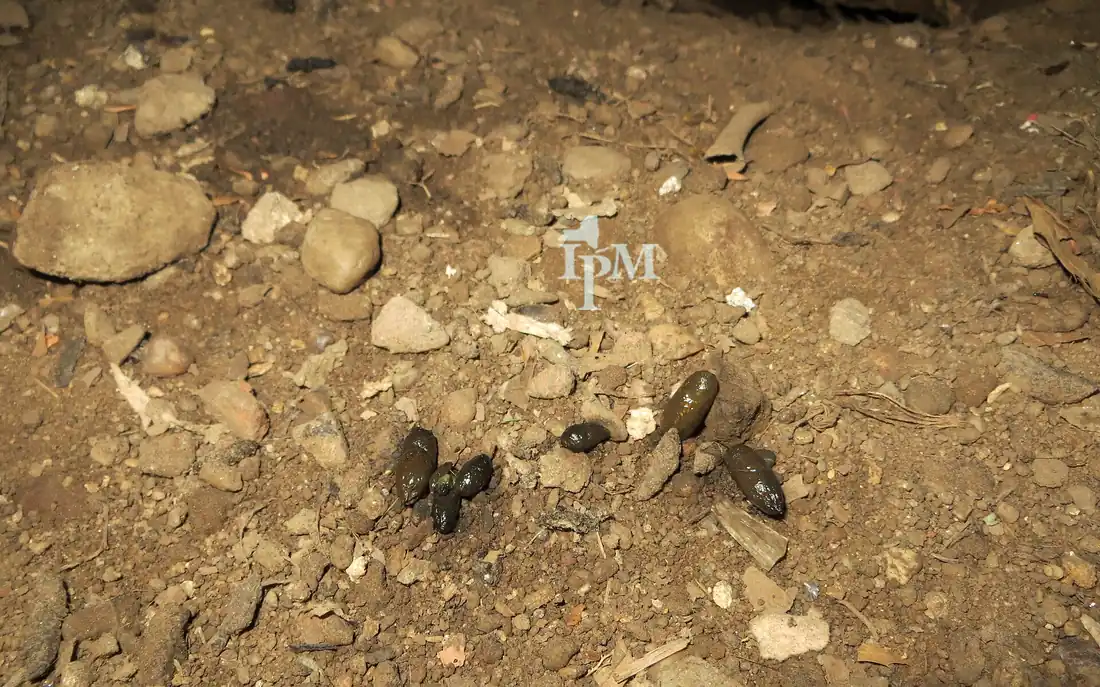
The size test: rice grain vs capsule
Droppings are usually the first evidence a Detroit homeowner finds, often in a kitchen drawer, under a sink, or along a basement wall. Before anything else, measure. A house mouse leaves droppings about 3 to 6 mm long, dark, and pointed at both ends, close to a grain of rice. A Norway rat leaves droppings about 12 to 18 mm long, roughly the size of a raisin or an olive pit, with blunt, rounded ends.
Shape backs up size. Mouse droppings taper to points because they dry quickly and are passed in large numbers, sometimes 50 or more in a day from one mouse. Rat droppings are thicker, smoother, and passed in smaller groups, often clustered in one latrine spot rather than scattered along a whole run. Fresh droppings of either kind are dark and soft; old ones turn grey, dry, and crumbly, which tells you whether the activity is current. Our signs and problems hub walks through the same identification for the droppings found in pantries and kitchen drawers.
Where each animal leaves them in a Detroit house
Mice live close to food and tend to drop as they travel, so their droppings show up in drawers, cupboards, along the backs of counters, and in the insulation of an attic they are nesting in. Rats are more set in their routes. Norway rats in Detroit homes usually come up from the basement, so look along the foundation walls, near the floor drain, beside the water heater, and along the tops of basement beams where they run.
In older Detroit stock the map matters. About 86 percent of the city’s houses went up before 1970, and a third before 1939, so basements have coal chute frames, block or stone foundation joints, and old utility holes that give rats a way in from the soil side. Droppings concentrated at the base of one foundation wall usually mark the run between an entry point and food or water. Droppings spread thinly through kitchen storage usually mean mice living inside the room itself.
| Mouse droppings | Norway rat droppings | |
|---|---|---|
| Typical size | 3 to 6 mm, like a grain of rice | 12 to 18 mm, like a raisin or olive pit |
| Ends | Pointed at both ends | Blunt, rounded capsule ends |
| How many | Many, scattered along runs; one mouse can leave 50 or more a day | Fewer, grouped in latrine spots |
| Where in Detroit homes | Drawers, cupboards, counters, attic insulation | Basement walls, floor drains, beam tops, garage corners |
| Fresh vs old | Fresh is dark and soft; old turns grey and crumbly | Fresh is dark and shiny; old dries dull and hard |
Not sure which animal left them? Call for an inspection and get the entry points mapped before the problem grows.
Call (313) 476-6003What to do once you know which one it is
Do not sweep or vacuum dry droppings. Dry sweeping puts dust from the droppings into the air you breathe. Wet the area down first with a household disinfectant or a bleach solution, let it soak, then wipe it up with paper towels while wearing gloves, and bag everything straight away. That wet method is the safe way to handle a small find, and our page on rodent droppings cleanup covers the full safety routine.
Identification also decides the work that follows. A mouse problem is mostly an inside problem: nesting in walls, attics, and stored goods, fixed by trapping and sealing gaps as small as a pencil width. A rat problem in Detroit is usually a building problem tied to the basement and the soil outside it, and it needs the entry route found and closed, which is what an inspection maps before any treatment starts. Counting droppings cannot tell you how many animals there are, but the size alone tells you which job you are booking.
- Photograph the droppings next to a coin before you clean, so the size is on record
- Note the room and the exact spot; the pattern points to the entry route
- Wet-clean a small find with disinfectant; never dry sweep or vacuum it
- Check the same spot in two days; fresh dark droppings mean the run is active
- If droppings keep appearing, book an inspection to find how they are getting in
Questions Detroit Homeowners Ask
Can droppings tell me how many rodents I have?
Not a reliable count. One mouse can leave dozens of droppings in a single night, and rats reuse one latrine spot, so a big pile can come from a small number of animals. Droppings are best used for identification and for judging whether activity is fresh, not for counting. Numbers come from the inspection: nesting sites, runs, and entry points show how established the problem is.
Are mouse droppings and rat droppings equally risky to clean up?
Treat both the same way. Any rodent droppings can carry germs, and the risk comes from breathing dust raised by dry cleaning. Wet the droppings with disinfectant first, wear gloves, wipe rather than sweep, and wash your hands after. Large accumulations, especially in an attic, are a cleanup job rather than a DIY wipe-down.
I found droppings but have never seen a rodent. Is it old?
It could be either. Old droppings are grey, dry, and crumble to dust when pressed with a stick. Fresh ones are dark and hold together. Clean the spot using the wet method, then check it over the next two or three days. New droppings in the same place mean the run is still active and the entry point is still open.
Why do I find rat droppings in the basement but nothing upstairs?
That is the normal Norway rat pattern in Detroit. Rats enter at foundation level, often through a broken drain or a gap around a pipe, and they stay low where it is damp and undisturbed. They may never come upstairs at all. The fix is at the entry level: the basement route has to be found and sealed, not just the droppings cleaned.
More From the Blog
Work through the other Detroit rodent guides on the blog index, or go straight to the service page that matches your problem from the services list.