The normal timeline, day by day
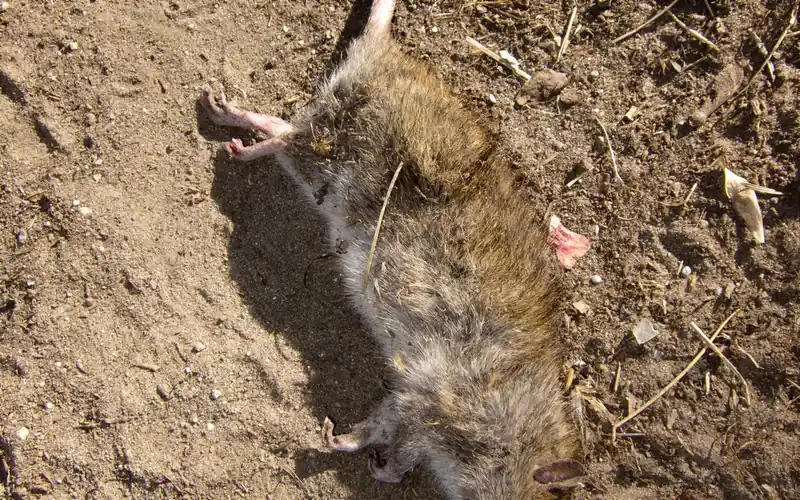
The first day or two after a mouse dies, there is often no smell at all, which is why the timing confuses people. The odour builds as decomposition starts, usually becoming obvious around day two or three, and it is at its worst somewhere between day four and day eight. After the peak, the smell backs off steadily as the body dries. In a heated room with normal airflow, most mouse smells are gone inside two weeks.
Rats take longer. A Norway rat is many times the weight of a mouse, holds more moisture, and can keep a wall or a basement corner smelling for three to four weeks. Season plays a part too. A body in a cold Detroit basement in January dries slowly and may smell faintly for a long stretch, while one in a warm wall in August peaks hard and finishes faster. The smell in the house is one of the symptom patterns our signs and problems hub covers alongside scratching and droppings.
What makes the smell last longer
Three things stretch the timeline: size, heat with moisture, and still air. A body trapped in an insulated wall void has almost no airflow, so it dries slowly and the smell soaks into the insulation and the drywall paper around it. Those materials can hold a low-level odour even after the body itself has dried, which is why a faint smell sometimes lingers near one baseboard after the main event is over.
A second animal is the other common cause of a smell that will not quit. Mice travel together, and where one died in a wall, a second sometimes follows the same run. If the smell fades and then comes back at full strength, that is usually a new death, not the old one lasting longer. Repeated deaths in the same run point to an open entry point, and that is a sealing problem, not a cleaning problem.
| Situation | Typical smell length | Why |
|---|---|---|
| Mouse in an open room or attic | About 5 to 10 days | Airflow dries the body quickly |
| Mouse inside a wall void | About 1 to 3 weeks | Still air slows drying; odour soaks into insulation |
| Rat in a wall or basement | About 3 to 4 weeks | Much larger body, more moisture to dry |
| Smell that returns after fading | Starts over | Usually a second animal on the same run |
Smell you cannot reach or one that keeps coming back? Call and we will find where it is coming from and how they are getting in.
Call (313) 476-6003What you can do while it runs its course
Ventilation is the one thing that genuinely helps: open windows near the source when weather allows and run a fan to move air out of the room. Baking soda and bowls of vinegar absorb a little of the surface odour, and they do no harm, but neither reaches a body inside a wall. Scented sprays only stack a second smell on top of the first.
If the body is reachable, in an attic, a basement, or under an appliance, removing it ends the problem at once; that removal, done with gloves and a sealed bag, is the core of dead rodent removal. If the smell is strong enough to find but the body is inside a finished wall, cutting the wall is a judgement call based on how bad the peak is. An attic cleanup visit can also deal with the insulation a body has soaked. What never helps is waiting to deal with the entry point: the smell ends, the run stays open, and the next mouse uses it.
- Ventilate the room; moving air shortens the whole timeline
- Remove any body you can safely reach, gloved and double-bagged
- Treat lingering baseboard odour as soaked material, not a live problem
- A smell that returns at full strength usually means a second animal
- Seal the entry run once the smell ends, or expect a repeat
Questions Detroit Homeowners Ask
Why does the smell seem worse at certain times of day?
Heat and air movement change through the day. When the heat runs or the sun warms a wall, air inside the void expands and pushes odour into the room, so the smell often peaks in the evening or near heating vents. A smell that comes and goes with the heating cycle usually means the body is in a wall or duct run, not out in the open.
Can a dead mouse in the wall make my family sick?
The smell itself is unpleasant but the main health concern is brief and low for a single mouse in a typical home. The bigger issues are the flies a body can draw and the bacteria at the body itself, which is why a reachable body should be removed with gloves rather than handled bare-handed. Anyone with breathing problems should keep out of the worst room until the peak passes.
Will the smell ever just not stop?
A single body always dries out in the end, so the smell always stops. A smell that runs past a month is almost never one animal: it is a second death, a body in standing water or damp soil under a slab, or soaked material that needs to come out. That is the point where finding the source beats waiting.
Should I cut open the wall to remove it?
Only when the peak is unbearable and the location is pinpointed, usually by the strongest point of the smell in a quiet room. Cutting in the wrong stud bay leaves you with a repair bill and the smell. Often the better order is to wait out the worst week, then seal the entry run so it does not happen again.
More From the Blog
Work through the other Detroit rodent guides on the blog index, or go straight to the service page that matches your problem from the services list.